Best DMARC Monitoring Tools in 2026: 6 Compared (Honest Review)
Roughly half of DMARC-publishing domains never receive a single report. Our
February 2026 scan of 5.5 million Tranco domains found that 53.5% of DMARC
records include a rua= tag — within one percentage point of Fortra’s 52.3%
across the top 10 million domains in their Q2 2025 adoption report. Translated
to the full population, only 16.3% of domains have any DMARC telemetry
flowing at all. The other 83.7% are flying blind.
Picking the right dmarc monitoring tools is what closes that visibility
gap before a spoofing campaign, a misconfigured SaaS sender, or a
deliverability regression turns into customer complaints. And visibility is
not the only gap. Only 30.4% of domains in our scan publish any DMARC
record at all, and just 12.8% sit at p=quarantine or p=reject.
Publishing DMARC is not the same as enforcing it. Enforcing is not the same as
monitoring. Monitoring is the only one of the three that compounds — every
report you ingest sharpens your picture of who legitimately sends mail for
you, and who does not.
This article walks six tools through one transparent rubric and four pieces of hard evidence: protocol coverage, dated pricing, aggregated G2 and Capterra sentiment, and switcher mechanics. We score every cell. We name where each tool falls short. We do not place DMARCguard at the literal #1 spot, because that is not how an honest comparison works. For the underlying scan methodology, see our email authentication research — the Tranco 5.5M sample, the February 27, 2026 collection date, and the sample-sensitivity caveats are documented there.
Six tools. One rubric. Dated prices. No #1 spot. Jump straight to the 7-dimension rubric, the parity matrix, the pricing snapshot, or the honest scoring summary.
How we evaluated each tool — the 7-dimension equal-weight rubric
No incumbent listicle on the best dmarc monitoring tools SERP publishes per-tool scorecards against transparent weights. CTO Club publishes top-level weights but hides the per-tool decomposition that would let a buyer audit them. Postmark explicitly declines to rank, calling a single best tool “impossible.” EmailToolTester and EmailVendorSelection list features without any scoring method at all. That opacity is itself the gap this rubric reacts to.
We chose equal weights because reliable importance information across SMB, MSP, and enterprise buyers does not exist in any public dataset we could find. Robyn Dawes’ 1979 paper The Robust Beauty of Improper Linear Models in Decision Making showed that unit weights match or beat regression-optimal and expert-elicited weights once variables and their direction are correctly chosen — they are robust to misspecification and immune to overfitting. Danielson and Ekenberg’s 2017 paper A Robustness Study of State-of-the-Art Surrogate Weights for MCDM qualifies that finding: rank-order surrogates beat equal weights when reliable importance information exists, but equal weights remain a defensible baseline when it does not. Our case is the second one.
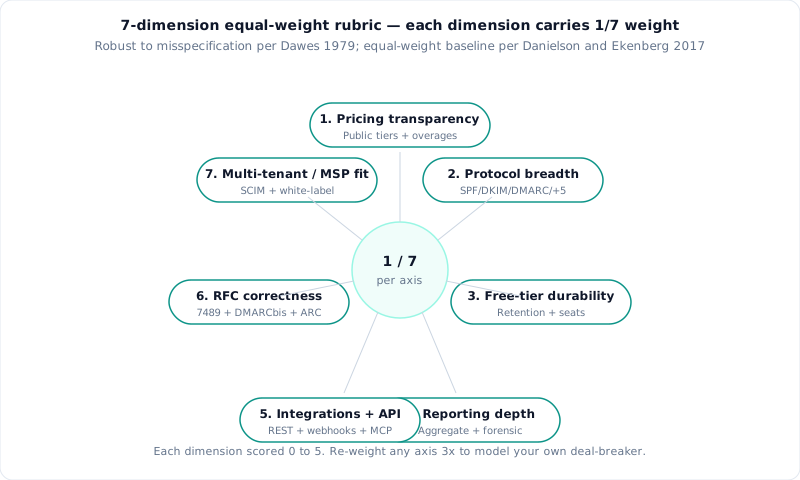
Every dimension below is scored 0 to 5, with explicit pass-fail gates inside each scale rather than smearing must-haves into composite averages. Every dmarc reporting tool in this list is scored against the same rule. The rubric exists so you can re-weight any column to 3× and re-rank the table for your own priorities — protocol breadth deal-breaker, pricing-transparency deal-breaker, MSP-fit deal-breaker.
| # | Dimension | What it measures (0–5 scale) |
|---|---|---|
| 1 | Pricing transparency | 0 = no public pricing; 1 = “starting at” only; 3 = full tier prices + per-domain caps; 5 = full prices + overage rates + per-tenant/MSP rates |
| 2 | Protocol coverage breadth | Count from {SPF, DKIM, DMARC, BIMI, MTA-STS, TLS-RPT, ARC, DANE}: 0 = ≤1; 3 = 4–5; 4 = 6; 5 = 7–8 |
| 3 | Free-tier durability | 0 = none; 1 = ≤14-day trial; 3 = ≥30-day retention with parsed reports; 5 = ≥6-month retention, no feature gating beyond seats/domains |
| 4 | Reporting depth | 0 = aggregate only, no parse detail; 3 = + forensic (RUF) ingestion; 4 = + TLS-RPT + schema-drift logging; 5 = + named-source identification + DMARCbis fields |
| 5 | Integrations / API surface | 0 = none; 2 = REST API read; 3 = REST + webhooks; 4 = + ≥3 named SIEM/PSA connectors; 5 = + documented MCP server or equivalent |
| 6 | RFC correctness | 0 = fails alignment test; 2 = + correct PSL boundary; 3 = + PSD/tree-walk per DMARCbis; 4 = + ARC chain validation; 5 = + published DMARCbis readiness statement |
| 7 | Multi-tenant / MSP fit | 0 = single-tenant; 2 = + delegated admin; 3 = + per-tenant billing; 4 = + white-label/branded portal; 5 = + per-tenant SSO/SCIM and partner API |
We deliberately cut four dimensions from the long list. Support quality is verifiable only at 2 out of 5 — marketed SLAs are public; actual response quality is not. UX and remediation guidance are subjective without trial accounts and bias the rubric toward whichever tool the author tested most. Switcher and export friction is real, but it is more honest as part of the Integrations dimension than as a stand-alone score. Data residency is better used as a binary pre-filter (does it host in your jurisdiction or not?) than smeared into a composite.
The honest disclosure: equal weights miss when buyers have a single deal-breaker — protocol breadth for a regulated industry, MSP fit for a managed-service business, pricing transparency for procurement. If your deal-breaker exists, weight that column at 3× and re-read the matrix in Honest scoring summary. The composite is a starting point, not a verdict.
Quick verdict — who each tool is for
The TL;DR if you want one paragraph and a short answer.
- SMB or one-domain teams running DMARC for the first time — DMARCguard Hobbyist if a 2-domain free tier with 7 protocols fits, otherwise Postmark’s digest model for the first month and a paid tool when you outgrow it.
- SMB with budget, single-tool buyer — EasyDMARC if you want a polished UI and are happy paying $35.99 per month annual; DMARCguard if you want broader protocol coverage at a lower per-domain rate.
- Multi-domain MSP or reseller — PowerDMARC has the most mature MSSP onboarding flow of the six, with three published 2025 case studies (Primary Tech, Digital Infinity, S-IT). DMARCguard Enterprise is white-label plus SCIM but custom-quoted. Both are quote-only at scale. For the packaging and margin side, see the MSP operator’s guide to selling DMARC.
- DevOps-first teams that want API and automation — DMARCguard is the only vendor in this list with a documented MCP server (17 tools today). Otherwise, PowerDMARC’s API on Enterprise is the next closest option.
- Enterprise with annual procurement and a DNS-team-removal goal — Valimail Enforce starts at $5,000 per year quote-based; dmarcian Enterprise lists at $499 per month annual. Both fit procurement; both ask for a sales call.
- Free DNS swiss-army with no DMARC ingest needed — MXToolbox SuperTool remains the SOC and NOC bookmark. Pair it with a real DMARC monitor; do not use it as one.
The best dmarc monitoring service for you is the one whose top-ranked column matches your top-ranked priority. Re-weight before you decide.
If your top-ranked priority is “free, forever,” start with our roundup of the best free DMARC tools before committing to any paid tier. And if the question is whether to pay at all, free vs paid DMARC monitoring names the gaps that justify a paid tier and the cases where free is the right end state.
Feature & protocol parity matrix
None of the five ranking listicles on the SERP shows protocol coverage as a comparable column. Some mention BIMI in prose. Some skip MTA-STS. None render the eight-protocol family as one matrix you can compare across. We do.
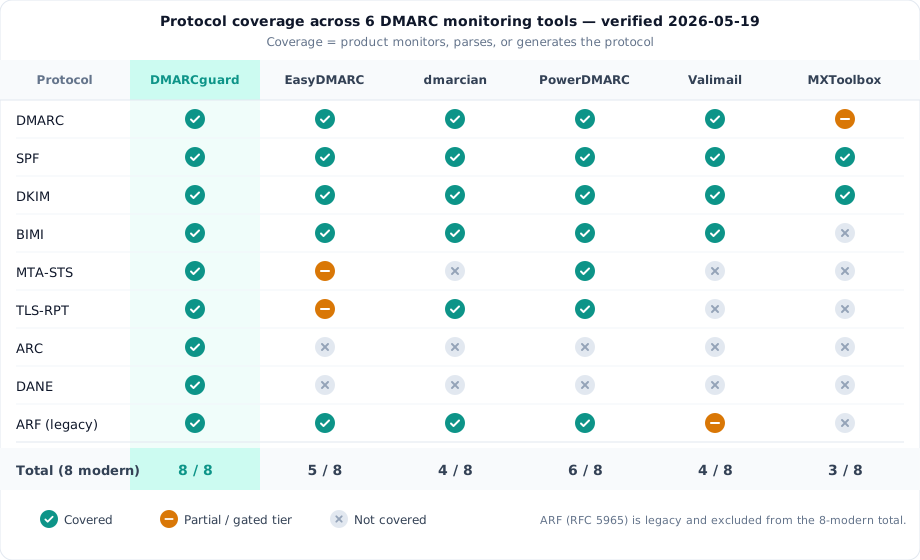
The convention below: coverage means the product monitors, parses, or generates the protocol. A free SPF lookup tool is not the same as continuous SPF monitoring. ARF is the legacy forensic-reporting format under RFC 5965 — not part of the standard eight modern protocols, but called out because some buyers still require it.
| Tool | DMARC | SPF | DKIM | BIMI | MTA-STS | TLS-RPT | ARC | DANE | ARF | Total (of 8 modern) |
|---|---|---|---|---|---|---|---|---|---|---|
| DMARCguard | Yes | Yes | Yes | Yes | Yes | Yes | Yes | Yes | Yes | 8/8 |
| EasyDMARC | Yes | Yes (EasySPF) | Yes | Yes | Yes (Premium+) | Premium-only parsed | No | No | Yes | 5/8 |
| dmarcian | Yes | Yes (Surveyor) | Yes (Inspector) | Yes | No | Yes | No | No | Yes | 4/8 |
| PowerDMARC | Yes | Yes (PowerSPF) | Yes | Yes (PowerBIMI) | Yes (hosted) | Yes | No | No | Yes | 6/8 |
| Valimail | Yes | Yes | Yes | Yes (Amplify) | No | No | No | No | Limited | 4/8 |
| MXToolbox | Policy lookup only | Yes (record check) | Yes (record check) | No | No | No | No | No | No | 3/8 |
Why ARC and DANE matter in 2026: ARC (Authenticated Received Chain, RFC 8617) is what lets mailing-list and forwarded mail survive DMARC enforcement — without ARC chain analysis you cannot tell whether a quarantine was caused by a real spoofer or a mailman.org list rewriting your headers. DANE/TLSA (RFC 6698) is the DNS-anchored TLS pinning that EU NIS2 auditors increasingly ask about, and it is the only mechanism that defends transport encryption against the active-attacker class that MTA-STS does not. See our ARC chain analysis explainer and DANE / TLSA guide for depth.
Valimail’s MTA-STS and TLS-RPT gap is not editorial — it is documented by a verified G2 reviewer in November 2025: “I feel that the lack of certain advanced features is a drawback. For example, MTA-STS management and TLS reporting are missing.” For a deeper feature-by-feature breakdown of any single competitor, see our compare pages: EasyDMARC vs DMARCguard, dmarcian vs DMARCguard, PowerDMARC vs DMARCguard, and Valimail vs DMARCguard.
2026 pricing snapshot
Postmark’s listicle is two years stale. EmailVendorSelection has a $49-vs-$99 contradiction with EmailToolTester on ZeroBounce. Both EmailToolTester and EmailVendorSelection skip MXToolbox entirely. Below is every published 2026 price, dated.
If you are reading this after 2026-06-09, the pricing snapshot is more than 21 days old. Click each Source URL before quoting any number; we re-stamp this table on a rolling cadence.
| Vendor | Free tier | Entry paid tier | Mid tier | Top published tier | Contact-sales? | Source URL | Verified |
|---|---|---|---|---|---|---|---|
| DMARCguard | Hobbyist: 2 domains, 1 user, 30 days retention, 7 protocols | Pro: $29/mo including 2 domains, then $15/domain (3–10); annual $290/yr. Founding: 50% off, locked 24 months | Pro 11+ domains: $10/domain/mo standard / $5 founding | Enterprise: Custom (SAML SSO, SCIM, SIEM, white-label) | Yes (Enterprise) | https://dmarcguard.io/pricing/ | 2026-08-23 |
| EasyDMARC | 1 domain, 1,000 emails/mo, 14-day retention | Plus: $35.99/mo annual ($44.99 monthly), 2 domains, 100K emails | Premium (“Most Popular”): $71.99/mo annual ($89.99 monthly), 4 domains, up to 5M emails | Enterprise: Custom (unlimited domains, 3-yr retention, dedicated DMARC engineer) | Yes (Enterprise + MSP both quote-only) | https://easydmarc.com/pricing/easydmarc/businesses | 2026-05-19 |
| dmarcian | Personal: 2 active domains, 1,250 msgs/mo, non-business audited | Basic: $19.99/mo annual ($24 monthly), 2 domains, 100K msgs | Plus: $199/mo annual ($240 monthly), 8 domains, 1M msgs | Enterprise: $499/mo annual ($5,988/yr), 15 domains, 5M msgs, API + SSO | Yes (Custom / Tailored Pricing) | https://dmarcian.com/pricing/ | 2026-05-19 |
| PowerDMARC | 1 domain, 1 user, 10K emails/mo, 10-day retention | Basic: $8–$250 volume slider (default 100K bucket: $15/mo monthly, $12/mo annual) | (No mid SKU — Basic absorbs the volume range up to 2M emails) | Enterprise: Custom Quote (SAML, API, SIEM, RBAC, custom DPA) | Yes (Enterprise + Partner Program for MSP/MSSP) | https://powerdmarc.com/power-dmarc-pricing-policy/ | 2026-05-19 |
| Valimail | Monitor: free forever, 5 users, “Limited” automated DMARC | Enforce Starter: “Starting at $5,000/year”, quote-based | Enforce Premium: Contact us for custom pricing | Enforce Enterprise: Contact us for custom pricing (AWS Marketplace estimate $60,000/yr; per-domain $1,500, per-100K-email $1,000 overage) | Yes (Premium, Enterprise, Amplify) | https://www.valimail.com/pricing/ | 2026-05-19 (see HIGH-RISK note below) |
| MXToolbox | 1 free monitor with top 30 blacklists; no DMARC-specific free tier | Delivery Center: $129/mo flat for up to 5 domains; per-additional-domain rate undisclosed | (No mid SKU published — gap from $129 to $399) | Delivery Center Plus: $399/mo; Managed Email Delivery Services Per Year, Contact Us | Yes (Managed Services) | https://mxtoolbox.com/c/products/deliverycenter | 2026-05-19 |
DMARCguard pricing is quoted net: excl. VAT & sales tax. Competitor prices are shown as each vendor publishes them.
Two facts the incumbent listicles miss.
Free-tier evolution. EasyDMARC’s mid-2024 cut from 10,000 to 1,000 emails on the free tier — and from unlimited domains to 1 — was a 90% volume reduction shipped without a blog announcement. We document the Trustpilot complaints in our why-teams-move-off-EasyDMARC post and the best free dmarc analyzer comparison there. dmarcian’s 1,250-message Personal tier is locked to non-business domains and audited — a free evaluation that turns into a forced upgrade is a real risk if you start with it on a business domain.
Hidden costs. PowerDMARC’s terms-and-conditions §7.8 is explicitly non-refundable — “All services are non-refundable unless explicitly specified” — even though the live pricing page markets “no contract, cancel anytime.” Valimail’s AWS Marketplace listing defines per-domain $1,500 and per-100K-email $1,000 overage rates, plus 12-, 24-, and 36-month annual lock-ins paid up-front. MXToolbox draws repeated billing-friction complaints — a Capterra reviewer wrote “Their customer service is atrocious. If you sign up for the free trial and try to cancel, do not expect to get your money back.”
For corroboration of our scan numbers, see Fortra’s DMARC Adoption Trends Q2 2025, EasyDMARC’s 2026 adoption report, and Red Sift’s BIMI Radar global adoption guide.
DMARCguard — what we are, what we are not
From our perspective as the maintainer of DMARCguard, here is what we cover and where we fall short. We introduce ourselves first in this deep-dive sequence so the disclosure stays honest — burying our own entry mid-list would feel like a stack.
What we are. DMARCguard monitors all nine modern email-authentication
protocols: DMARC, SPF, DKIM, BIMI, MTA-STS, TLS-RPT, ARC, DANE, and
ARF. Seven ship on the free Hobbyist tier; DANE and ARF are Pro add-ons. We
expose every capability through a documented MCP server with 17 tools today
— the only one of the six vendors with native model-context integration.
Named-sender identification surfaces “Mailchimp” and “Google Workspace”
instead of 52.24.128.5. Pricing is $29/mo including 2 domains, then $15/domain (3–10) and $10/domain (11+).
What we are not. We do not hold a SOC 2 certification today — we are a bootstrapped company and will pursue it when our customers’ compliance needs demand it; we will not call ourselves audited until we have the report. We do not currently publish a self-serve MSP white-label tier; multi-tenant lives inside Enterprise custom quotes. We are newer than dmarcian (2012) and EasyDMARC, and we do not have the multi-year G2 review corpus those incumbents do. The
founding-rate banner expires and converts to standard rates after the 24-month lock.Rubric scorecard: Pricing transparency 5/5 (every tier price, every add-on, every overage policy is on /pricing). Protocol breadth 5/5 (8 of 8 plus ARF). Free-tier durability 4/5 (30-day retention vs. our own 90-day target for a perfect 5). Reporting depth 4/5 (aggregate, forensic, TLS-RPT, schema-drift logging — DMARCbis tree-walk readiness ships next). Integrations 5/5 (REST API, webhooks, three SIEM connectors, the MCP server). RFC correctness 5/5 (RFC 7489, ARC validation, DMARCbis readiness statement on the research page). MSP fit 3/5 (multi-tenant lives in Enterprise; no self-serve MSP tier).
G2, Capterra, and TrustRadius aggregates: not yet available. Our review corpus is too small to publish a meaningful average — that is a fact, not a hidden weakness. If review-volume social proof is your dominant signal, weight that column heavily and pick from the established players.
Try DMARCguard free — Hobbyist plan covers 2 domains and 7 protocols with 30-day retention, no credit card. See all DMARCguard tools and DMARCguard pricing for the full picture.
EasyDMARC — polished SMB UI with rising commercial friction
EasyDMARC carries the highest aggregate G2 rating in this list: 4.8 out of 5 across 187 reviews (88% five-star), plus Capterra 4.8/5 over 25 reviews. Praise themes concentrate on setup matching the marketing claims, support responsiveness, dashboard digestibility, and single-pane SPF/DKIM/DMARC management. Matt V. on G2 in 2025: “I like EasyDMARC because it really is easy to use and is exactly as advertised.”
Complaint themes from the 2024–2026 review corpus also concentrate. Loyalty pricing (an anonymous G2 verified user, 2025: “I find the product a bit expensive, and customer loyalty does not seem to be strongly reflected in the pricing model”), upsell pressure (Jeremy H., G2 2025: “It really wants to push you to a more costly plan at every turn”), and hosted-DNS lock-in. The texture turned in December 2025 with the first surfaced 1-star, an Insurance reviewer citing “interface is slow, exported output data cannot be trusted.”
Pricing snapshot. Free: 1 domain, 1,000 emails/mo, 14-day retention. Plus: $35.99/mo annual ($44.99 monthly). Premium: $71.99/mo annual ($89.99 monthly). Enterprise and MSP are both quote-only.
Free-tier evolution callout. EasyDMARC’s mid-2024 cut took the free plan from 10,000 emails per month to 1,000 — a 90% reduction — and from unlimited domains to 1, shipped without a blog announcement. We covered the migration mechanics in our why teams move off EasyDMARC post.
Rubric scorecard: Pricing transparency 4/5 (MSP page is fully quote-only). Protocol breadth 3/5 (5 of 8 — no ARC, no DANE, TLS-RPT parsed reports gated to Premium). Free-tier durability 2/5 (14-day retention). Reporting depth 4/5. Integrations 3/5 (PSA depth is real but no MCP). RFC correctness 4/5. MSP fit 2/5 (quote-only with no published rate card).
Best for: SMB on a single tool, willing to pay $35.99 per month or more for a polished UX.
See the full EasyDMARC vs DMARCguard comparison for feature-by-feature detail.
dmarcian — the DMARC pioneer with a dated dashboard
dmarcian was founded in 2012 by a co-author of the DMARC specification and remains the longest-running specialist in this list. Praise themes concentrate on anti-spoofing efficacy, sub-24-hour support, and mission credibility — an anonymous G2 reviewer in February 2026: “dmarcian’s clear mission to promote email security and combat phishing resonates and I appreciate their work beyond pure profit motives.”
The aggregate scores tell a more mixed story. G2 sits at 3.5 out of 5 across only 5 reviews — small sample, but the direction is unambiguous. Capterra is 4.5/5 across 4 reviews, also small. Complaints concentrate on paid-tier expense for SMBs (“their paid services can be expensive for smaller organizations”), surprise billing (“I thought it was free, but then randomly saw that we were being billed double digits”), a steep learning curve, and integration gaps. A defection narrative shows up on rival product pages — Keith W. on Capterra in July 2024 switched from dmarcian to DMARC Report citing a better price point. Multiple 2026 third-party reviews call the dashboard “dated.”
Pricing snapshot. Personal: free, 2 domains, 1,250 msgs/mo, non-business audited. Basic: $19.99/mo annual ($24 monthly), 2 domains, 100K msgs. Plus: $199/mo annual ($240 monthly), 8 domains, 1M msgs. Enterprise: $499/mo annual ($5,988/yr), 15 domains, API + SSO. Refund and cancellation policies are not disclosed on the pricing page.
Trend signal. A staging URL dmarcian.com/pricing-updated/ was indexed
during research, and residual Lorem Ipsum placeholder text on the Personal
monthly card suggests active editing inside the publish window.
Rubric scorecard: Pricing transparency 4/5 (refund opaque). Protocol breadth 2/5 (4 of 8 — no MTA-STS, no ARC, no DANE). Free-tier durability 2/5 (1-month retention plus the non-business gate). Reporting depth 4/5. Integrations 3/5. RFC correctness 5/5 (DMARC-pioneer credibility, RFC 7489 by a co-author). MSP fit 3/5.
Best for: teams that value DMARC-pioneer credibility and a quarantine workflow, willing to accept a dated dashboard.
For dmarcian alternatives, see our deep-dive post — and the dmarcian vs DMARCguard comparison for feature parity.
PowerDMARC — strong MSSP fit, sales-rep gating on premium
PowerDMARC carries the highest review volume and aggregate score among the specialists: G2 4.9 out of 5 across 240 reviews, 94% five-star, plus Capterra 4.7/5 over 7 reviews. They held G2 Leader status through all four 2025 quarters. Praise themes are consistent: sub-hour support, DNS-record setup ease, and — distinctively — MSP/reseller onboarding. Andy K., G2 2025: “The onboarding of us as an MSP/reseller and the onboarding of our first managed domains has been superb.” Three syndicated case studies in 2025 (Primary Tech, Digital Infinity, S-IT) document the same flow. Among the specialists, PowerDMARC has the second-broadest protocol coverage at 6 of 8.
Complaints concentrate on multi-tenant friction inside the MSSP portal — client-switching tedium, portal performance, root-cause discoverability (“the user interface is not overly intuitive and finding root causes of issues not always that easy,” November 2025), and sales-rep gating on premium add-ons.
Pricing snapshot. Free: 1 domain, 10K emails/mo, 10-day retention. Basic: $8 to $250 volume slider (default 100K bucket: $15/mo monthly, $12/mo annual), 5 domains, 1-year retention, 15-day free trial no CC. Enterprise: Custom Quote — SAML SSO, API, SIEM, RBAC, custom DPA. Partner Program (MSP/MSSP/reseller) is also fully Custom.
Refund-policy contradiction. The site copy markets “cancel anytime, pay as you go.” T&Cs §7.8 reads: “All services are non-refundable unless explicitly specified.” The AWS Marketplace listing matches the T&Cs. We dock Pricing transparency for the contradiction.
Rubric scorecard: Pricing transparency 3/5 (refund contradiction docks the score). Protocol breadth 4/5 (6 of 8 — no ARC, no DANE). Free-tier durability 1/5 (10-day retention). Reporting depth 4/5. Integrations 4/5 (API on Enterprise+). RFC correctness 4/5. MSP fit 5/5 — the highest score of any tool in this list on this dimension.
Best for: MSPs and MSSPs onboarding multiple clients on a single dashboard with mature multi-tenant flows.
See the PowerDMARC vs DMARCguard comparison for feature parity.
Valimail — enterprise automation with quote-only friction
Valimail is the enterprise category’s most consistent winner on independent benchmarks: G2 4.6 out of 5 across 441 reviews (73% five-star), and #1 on G2’s DMARC Grid for 14 consecutive quarters through Winter 2026. Gartner Peer Insights sits at 4.8/5 over 9 reviews — small sample, but matching direction.
Praise themes are distinctive. Mark P. on G2 in November 2025: “I no longer have to manage DNS directly. There’s no need to involve the DNS team or deal with change tickets.” A verified G2 user, 2025: “Reporting is absolutely brilliant, it allowed us to move from policy none, to quarantine and to reject in no time.” The named-sender / SaaS-identification database is a verified differentiator — “saving time by identifying thousands of SaaS services.”
Complaints concentrate on premium pricing, vendor lock-in concern, explicit MTA-STS and TLS-RPT gaps (a verified G2 user, November 2025: “the lack of certain advanced features is a drawback. For example, MTA-STS management and TLS reporting are missing”), tier transparency, and sales push on the free tier. The “Expensive” cons-tag count on G2 grew from ~19 to 28 mentions across the Winter-2025-to-April-2026 window.
Pricing snapshot. Monitor: free forever, 5 users, “Limited” automated DMARC. Enforce Starter: “Starting at $5,000/year” — quote-based, no self-serve. Enforce Premium and Enterprise: contact for pricing. Amplify (BIMI add-on): contact. The AWS Marketplace listing estimates Enforce Enterprise at $60,000/yr on a 12-month contract; per-domain $1,500, per-100K-email $1,000 overage. Only private offers honored.
HIGH-RISK re-verify. DigiCert closed the Valimail acquisition on 2025-09-16. The pricing page still lives at valimail.com/pricing as of 2026-05-19, but a DigiCert-driven harmonization is the most credible near-term event in this set.
Rubric scorecard: Pricing transparency 2/5 (only Starter floor public). Protocol breadth 2/5 (no MTA-STS, no TLS-RPT, no ARC, no DANE). Free-tier durability 4/5 (no retention cliff stated; sales push docks one). Reporting depth 5/5. Integrations 3/5 (API gated to add-on). RFC correctness 4/5. MSP fit 3/5 (Enforce Enterprise multi-tenant only via private offer).
Best for: enterprise with annual procurement where DNS-team-removal is the primary win.
See the Valimail vs DMARCguard comparison for feature parity.
MXToolbox — free SuperTool, paid Delivery Center, no real DMARC parsing on free
MXToolbox is the SOC and NOC bookmark for free DNS, MX, and blacklist diagnostics, and it earned that reputation honestly. Diku N., G2 September 2025: “It is the evergreen tool for all the network security engineers as well as for the engineers who are working in SOC, NOC etc.”
Why MXToolbox is in this list. Searchers expect it — it ranks position 6
on the SERP for dmarc monitoring tools. Why it does not really fit.
MXToolbox SuperTool is a DNS and blacklist diagnostic suite. DMARC RUA
parsing requires Delivery Center at $129/mo (5 domains) or Delivery Center
Plus at $399/mo. The free tier includes no DMARC analytics. Honest framing
matters here: do not paper it over.
Aggregate scores: G2 4.1 out of 5 across 29 reviews (65% five-star, 10% one-star) — G2 currently displays “It’s been two months since this profile received a new review,” signaling slowing review velocity. Capterra is 4.5/5 across 6 reviews. Complaints concentrate on stagnant interface, free-tier shallowness for DMARC, alarming blacklist-alert wording, and trial-cancellation refund disputes. A Capterra reviewer’s verbatim summary: “Their customer service is atrocious. If you sign up for the free trial and try to cancel, do not expect to get your money back.”
Pricing snapshot. Free: 1 monitor with top-30 blacklists, no DMARC ingest. Delivery Center: $129/mo flat for 5 domains; per-additional-domain rate undisclosed. Delivery Center Plus: $399/mo. Managed Email Delivery Services: per year, contact us.
Rubric scorecard: Pricing transparency 2/5 (per-domain rate undisclosed). Protocol breadth 2/5 (3 of 8 — DMARC policy lookup, SPF record check, DKIM record check). Free-tier durability 1/5 (no DMARC ingest). Reporting depth 3/5 (Delivery Center). Integrations 2/5. RFC correctness 3/5. MSP fit 1/5.
Best for: free DNS and blacklist swiss-army; not for primary DMARC monitoring.
For the migration path off MXToolbox to a real DMARC parser, see our MXToolbox alternatives for DMARC reporting post.
Honest scoring summary
Every cell. Every score. Show the math.
| Tool | Pricing transp. | Protocol breadth | Free-tier durability | Reporting depth | Integrations / API | RFC correctness | MSP fit | Total / 35 |
|---|---|---|---|---|---|---|---|---|
| DMARCguard | 5 | 5 | 4 | 4 | 5 | 5 | 3 | 31 |
| EasyDMARC | 4 | 3 | 2 | 4 | 3 | 4 | 2 | 22 |
| dmarcian | 4 | 2 | 2 | 4 | 3 | 5 | 3 | 23 |
| PowerDMARC | 3 | 4 | 1 | 4 | 4 | 4 | 5 | 25 |
| Valimail | 2 | 2 | 4 | 5 | 3 | 4 | 3 | 23 |
| MXToolbox | 2 | 2 | 1 | 3 | 2 | 3 | 1 | 14 |
Equal weights are robust to misspecification, but they smear deal-breakers into composite scores. If protocol breadth is non-negotiable, re-weight that column to 3× and re-rank. If pricing transparency or MSP fit is the deal-breaker, do the same. The rubric exists so you can do that.
By unweighted total, DMARCguard sits highest in this rubric — but that reflects our advantage on protocol breadth and the MCP server, not editorial favoritism. The best dmarc software for your team is the one that matches your top-ranked dimension. PowerDMARC wins MSP fit. Valimail wins reporting depth. dmarcian and DMARCguard tie on RFC correctness. MXToolbox is in this list because searchers expect it, not because it competes on continuous DMARC monitoring — a 14-of-35 composite is the honest read.
How to switch DMARC monitoring tools without losing data
No incumbent listicle answers this question. The mechanics are not hard. They take 30 minutes of DNS work and 2 to 4 weeks of parallel monitoring, and your email flow is never affected during the cutover.
- Add the new tool’s
rua=mailto:to your DMARC record alongside the existing one. RFC 7489 §6.2 explicitly permits multiple comma-separatedrua=addresses in a single DMARC record. Receivers send aggregate reports to all listed addresses. There is no email-flow impact during this step — reports are sent by Gmail, Outlook, and Yahoo to the addresses in yourruatag; they do not affect inbox delivery. - Run both tools in parallel for 2 to 4 weeks. This overlap is what verifies sending-source parity. Confirm that every legitimate sender the old tool surfaced — Google Workspace, Microsoft 365, Mailchimp, SendGrid, internal mail servers — also appears in the new tool.
- Export aggregate report history from the old tool. CSV or JSON via the API if it exists; XML bulk download if not. EasyDMARC’s path is Aggregate Reports → by Compliance → Export as CSV. Once your account closes or downgrades, the data is gone.
- Verify named-sender coverage matches. Flag any sender that appears in only one tool’s dashboard — that is usually a discovery gap, not a real sender, but it is worth a manual confirmation before you cut over.
- Drop the old
rua=address. Update DNS to leave only the new tool’s address. Keep the receipt — the export from step 3 is your historical baseline.
Export friction to plan around. EasyDMARC docs advise deactivating EasySPF and Managed DMARC features and reverting to manual DNS records before cancellation; otherwise the services continue functioning post-cancellation but cannot be managed. PowerDMARC’s T&Cs are non-refundable. Valimail contracts are paid up-front for 12, 24, or 36 months with no mid-term refund — plan the cutover around your renewal date, not a calendar deadline. Your data should stay yours; the tool should not be holding it hostage.
For the underlying RUA syntax, see our DMARC protocol guide. For post-cutover validation, the free DMARC checker confirms your record is parsed correctly.
Frequently asked questions
What is the best DMARC monitoring tool in 2026?
No single tool wins for every buyer. Against an equal-weight, seven-dimension rubric covering protocol coverage, pricing transparency, free-tier durability, reporting depth, integrations, RFC correctness, and MSP fit, DMARCguard, PowerDMARC, and Valimail score highest in their respective categories — SMB with DevOps needs, MSP, and enterprise. Re-weight to your top criterion before deciding.
Are there free DMARC monitoring tools?
Yes. DMARCguard Hobbyist (2 domains, 7 protocols, 30-day retention), Valimail Monitor (5 users, limited automated DMARC), PowerDMARC Free (1 domain, 10K emails, 10-day retention), and EasyDMARC Free (1 domain, 1K emails, 14-day retention) all run continuously. dmarcian Personal is free but locked to non-business domains and audited.
Is MXToolbox enough for DMARC monitoring?
No. MXToolbox SuperTool checks the published DMARC policy record but does not parse aggregate (RUA) reports on the free tier. RUA parsing requires Delivery Center at $129 per month. For continuous DMARC monitoring, pair MXToolbox with a purpose-built tool from this list.
How much does DMARC monitoring cost in 2026?
Floors at $0 on the limited free tiers. SMB entry tiers run $8 to $36 per month (PowerDMARC Basic $8 to $15, dmarcian Basic $19.99, DMARCguard Pro $29 including 2 domains, EasyDMARC Plus $35.99). Enterprise runs $499 per month (dmarcian) to $5,000 plus per year (Valimail Enforce Starter) and roughly $60,000 per year for Valimail Enforce Enterprise on AWS Marketplace.
Which DMARC tool is best for MSPs?
PowerDMARC has the most mature MSSP onboarding flow per 2025 G2 case studies covering Primary Tech, Digital Infinity, and S-IT. DMARCguard Enterprise offers white-label and SCIM but is custom-quoted. EasyDMARC’s MSP page is fully quote-only with no published prices. Valimail Enforce Enterprise supports private-offer multi-tenant via AWS Marketplace.
Can I run two DMARC monitoring tools at the same time?
Yes. RFC 7489 §6.2 allows multiple comma-separated rua=mailto: addresses
in one DMARC record. Receiving mailbox providers like Gmail, Outlook, and
Yahoo send aggregate reports to all listed addresses. Most teams run
parallel monitoring for two to four weeks during cutover to verify
sending-source parity before dropping the old reporter.
What should I do next?
Start with the visibility gap. 53.5% of DMARC-publishing domains include a
rua= tag, which means roughly half do not — translated to the full 5.5M
Tranco scan, only 16.3% have any telemetry flowing. 30.4% publish DMARC.
12.8% enforce it. The visibility gap is bigger than the publication gap and
the enforcement gap combined. A real dmarc analyzer tool is what closes
it.
Four things to take from this comparison:
- The 7-dimension rubric is the only piece you should treat as universal. Re-weight to your deal-breaker. The composite is a starting point, not a verdict.
- The parity matrix is the protocol-coverage question solved. 8 of 8 vs 6 vs 5 vs 4 vs 3 — ARC and DANE are the two protocols incumbents leave out.
- Dated pricing is the trust signal. Every row in the snapshot is re-stamped on 2026-05-19 with a 21-day staleness gate.
- The switcher playbook is the cutover answer. RFC 7489 §6.2 lets you run two tools in parallel; your email flow never breaks during the migration.
The honest read on the best dmarc tool: nobody wins every column. Pick the dmarc monitoring tools entry that wins the column that matters most to you.
Try DMARCguard free — Hobbyist plan covers 2 domains and 7 protocols, no credit card.